
Night call, refloated the same shift
Emergency Salvage Of A Sunken Tugboat In The Port Of Antwerp
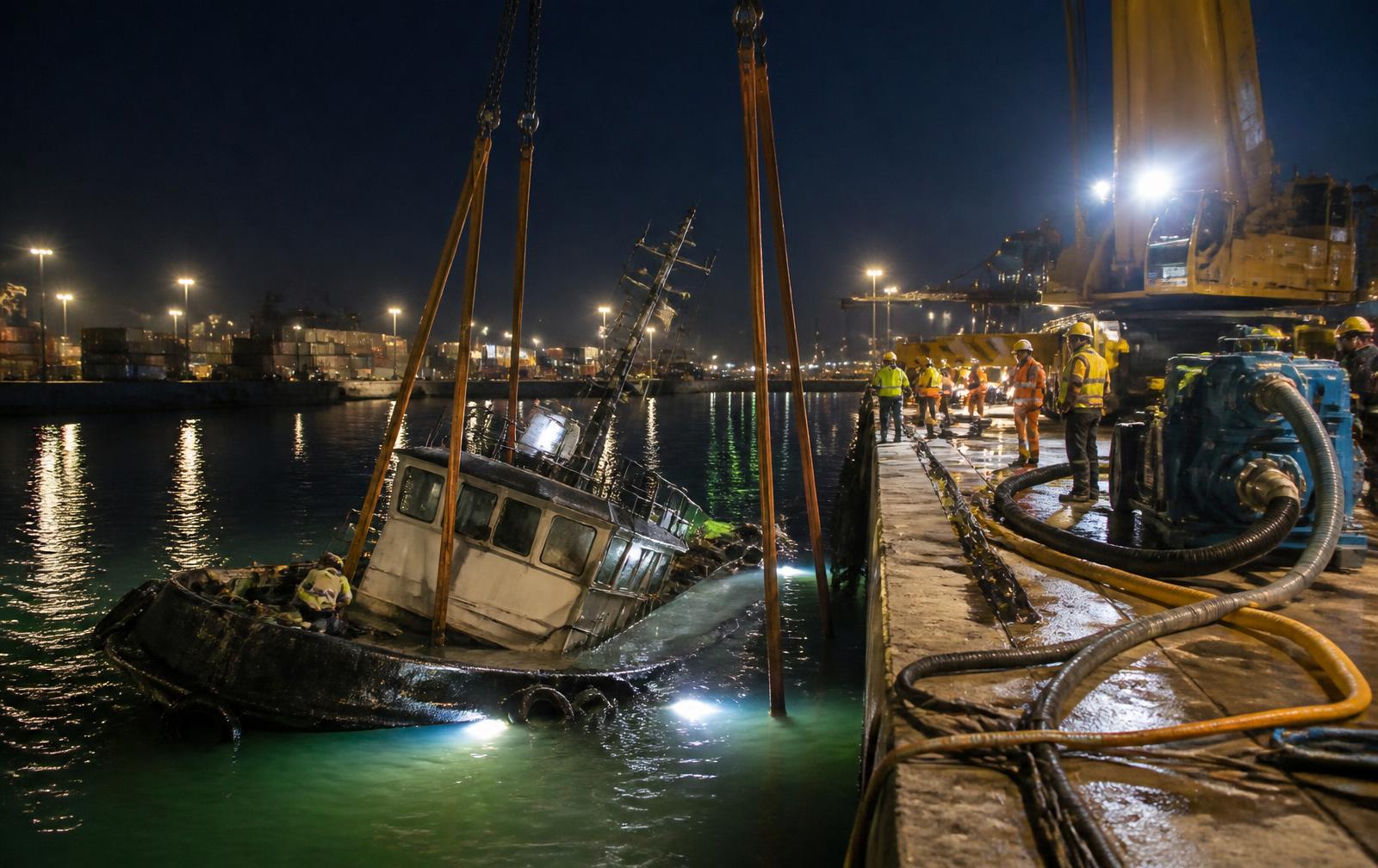
A 300-tonne harbour tug took on water at her berth and settled on the bottom alongside the quay. After a night-time call-out, the vessel was refloated in a controlled lifting and dewatering operation.
- Location
- Port of Antwerp, Belgium
- Operating company
- Antwerp Underwater Salvage
- Discipline
- Salvage And Emergency Response
- Client
- Withheld
300 t
Displacement of the harbour tug
4–5 h
From call-out to equipment on site
24/7
Emergency response desk
The operation
How the job ran
Chapter
A call in the middle of the night
The call came during the night: a 300-tonne harbour tug, berthed at a terminal in the Port of Antwerp, had slowly taken on water and settled completely on the bottom alongside the quay.
Our emergency response team mobilised immediately and was on site in the dark to assess the situation, judge how the vessel was lying and work out a recovery method that would be safe for both the tug and the terminal around her.
Chapter
A plan and a spread, inside hours
After the first inspection a dedicated salvage and lifting plan was drawn up, defining lifting points, sequence and load limits.
In parallel, heavy lifting equipment, hydraulic lifting systems, pumps and the supporting spread were mobilised. Within roughly four to five hours everything was on the quay and the recovery could start.
Chapter
Lifting and pumping at the same time
Commercial divers went in to reeve certified lifting slings underneath the vessel and to place pumping systems in the flooded compartments.
The tug was then raised gradually with heavy-duty lifting gear while water was pumped out in a controlled sequence. Both operations were monitored continuously to keep the vessel stable, avoid overloading her structure and keep her under control at every stage.
Chapter
Back afloat alongside the quay
Once enough buoyancy had been restored, the tug was refloated and secured alongside the quay.
She was handed back to her owner the same operation for further inspection and repair, with terminal activity around the berth restored.
Scope
Scope of work executed
- Night-time emergency call-out and site assessment
- Development of a lifting and salvage plan
- Mobilisation of heavy lifting and pumping equipment
- Diver installation of certified lifting slings and pumps
- Controlled lifting combined with staged dewatering
- Refloating, securing alongside and handover to the owner
Execution
Equipment, safety and reporting
Equipment deployed
- Heavy-duty lifting equipment and certified slings
- Hydraulic lifting systems
- High-capacity salvage pumps
- Surface-supplied diving spread with video and communications
Safety measures
- Salvage and lifting plan approved before the first lift
- Continuous stability and load monitoring during the lift
- Certified rigging and lifting gear with valid documentation
- Coordination with the terminal on exclusion zones and traffic
Reporting delivered
- Initial condition and situation assessment
- Lifting and salvage plan with load calculations
- Operation log of the lifting and dewatering sequence
- Handover record and post-refloat condition report
Outcome
Result
The tug was recovered in a very short timeframe. The controlled lift limited additional damage to the vessel, reduced disruption to terminal activity and allowed the tug to be transferred back to her owner for inspection and repair.
Documentation
Operational photography
Related
Next steps
Capability
Salvage & Emergency Response
Casualty assistance, refloating, recovery of objects and wreck removal, coordinated with owners, authorities and insurers. Salvage expertise, deployed where the operation demands it, across Belgian, Benelux and wider European waters.
Belgium
Antwerp Underwater Salvage
Marine construction, repair and vessel services
Contact
Discuss a comparable scope
Send us the structure, vessel or incident and we will confirm the right operating company, method and working window.